Wednesday, December 21, 2016

From Brain Storming to Prototype

Sometimes new patterns I create and test have been spawned in my head a day or two before the prototypes get tied and tested.  Sometimes it's weeks, or even months before I actually put materials to the hook.  That was the case with the Deer Hair Spook.  I had the idea in my head for a long time, finally ordered what I needed, and cranked out some flies to test.  Other designs don't sit in my mind long before they get put into reality.  It all depends on how much vise time I am getting and what else I want/need to tie.

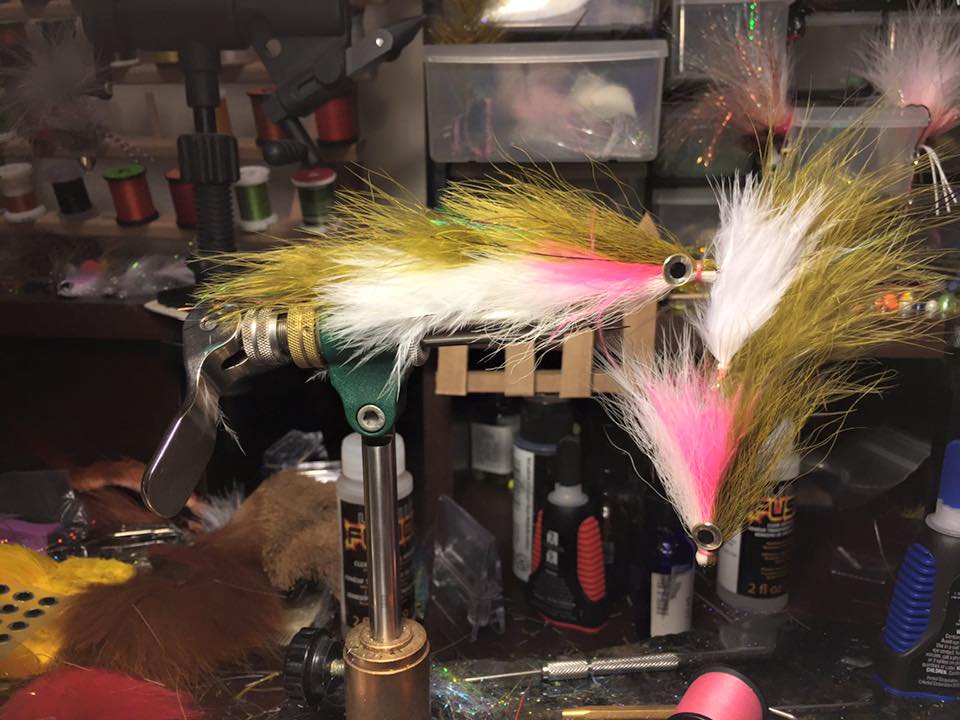
Another idea that has been rattling around for a while was to create a weighted large single hook streamer on a 60 degree jig hook.  I had the hooks, Mustad 32786 BLN's, for a while from tying another pattern.  The idea really started when I bought pocket cones for the first time and started experimenting with powder painting them.  The final nudge I needed was seeing another streamer pattern online, tied by Dan Seaman of Bug Wild, using a 60 degree jig hook.  It was one of those "Oh yeah, I forgot about that one idea" moments.  Here's the recipe I ended up going with.

Hook - Mustad 32786 BLN size 2/0
Cone - large pocket cone, powder painted
Additional Weight - 13 wraps of .030 non lead
Thread - 6/0 for most of the fly, 200den GSP for the deer hair collars
Tail - magnum zonker strips, double bunny style
Flash - holographic Flashabou
Hot Spot - Arctic fox
Body - Ice Chenille/Estaz
Wing - marabou, top and bottom (contrasting colors)
Legs - 3 strands per side
Collar - deer hair

When the zonker strips are tied in for the tail, I do use a spot of fabric adhesive to "weld" the rabbit strips together, but only near the hook.  I do not glue the strips together past that point to allow them to move more freely.  The addition of the non-lead wraps is actually very important, but not so much for weight.  The hole in the pocket cone is quite a bit larger than the diameter of the hook wire.  Adding the wraps gives the cone something to "seat" onto that holds them in place.  You can also add a touch of glue or epoxy to where the cone meets the wraps to really lock them in place.  Here's a prepped hook/cone, ready to be tied.


The marabou top and bottom helps to add a bit of bulk to the body, and the hot spots of Arctic fox bleed through the marabou nicely.  You can't really see the Ice Chenille/Estaz body, but the real purpose of the body material is to help push the marabou out away from the shank a bit.  Wrapping the body tightly helps force that marabou out away from the shank.  Here's the end result of the tying effort.


I'm going to be heading to the Mad River in Western Ohio during the week after Christmas to streamer fish for brown trout, and plan to take a few of these with me to test.  If nothing else, I will see them in the water and get a good feel for how the pattern will perform.  I'm intending for this to be a bass streamer, but I think it can produce on any species that will attack some meat. 

Monday, December 12, 2016

Cold Weather Blues

Living in SE Ohio, cold weather is expected when winter arrives.  Typically, this doesn't mean hard water until after the New Year, but this year it has arrived early.  I had the afternoon to myself on Saturday and had a severe case of cabin fever, but was very disappointed when I saw the local ponds all had a hard top.  No matter what the weather is doing, if there's open water, I can usually coax a bluegill to hand to give me a fix, but that wasn't happening on Saturday.  My next closest option is my local Ohio River tributary.  Roughly March-November the fishing can be pretty decent for a mixed bag of warmwater species, but the water has really been cooling off lately.  My hopes were not all that high.


I dredged small Clouser deep minnows in chartreuse/white and yellow/olive for about 90 minutes in the deepest water I could find with no takes.  No crappie, no sauger, no bass, nothing but icy guides and cold finger tips.  I caught no fish, but it wasn't Bob Clouser's fault. 


Defeated, I came home to the warmth of the house and got the feeling back in my extremities.  I beat the frigid weather the best way I knew how: dreaming of warmer weather and fish busting topwater bugs.  I sat down at the bench and cranked out some warm weather weapons for the spring.  Until then, I'll hope for a few warming trends to open the ponds back up and provide some action. 


Monday, December 5, 2016

Fresh Off the Vise

I was able to sit down for a little while at the bench over the weekend.  Not a ton of time, but enough to get a few things done.  I am planning a Mad River trip for shortly after Christmas and wanted to top off my streamer boxes with a few patterns to show the larger browns.  Usually, trips to the Mad (for me) come down to a decision: do I want to nymph fish and expect to catch a lot of smaller trout, or do I want to swing for the fences and fish bigger streamers and possibly get skunked.  In the past, I have liked catching fish too much to swing for the fences, but not this time.  I'll be carrying a 7wt and a pack full of meaty offerings to try and coerce a bigger eat.

On my last trip over to western Ohio, I did fish a few smaller sculpin patterns with some success.  One thing I noticed, though, was lots of short strikes on the rabbit strip tail.  The larger of the fish I landed, about 15", crushed the sculpin and got the hook, but I did miss several other fish.  I borrowed from the "sculpzilla" (http://www.charliesflyboxinc.com/flybox/print.cfm?parentID=153) hook attachment design to put a hook in the tail to nail the short strikers.  The rest of the sculpin pattern I kept the same.  It's a quick, easy streamer that has a good profile in the water.


I also re-stocked my supply of Complex Twist Bow River Buggers after I donated a few to a TU raffle last month.  I thought these color combos should get some attention from the trout.  I absolutely love the way these streamers move and breathe in the water, and they are a really fun pattern to tie.


The larger streamers I will be taking with me that I also plan to fish are Mike Schmidt's articulated Maraceiver patterns.  I did a few in yellow/tan and a couple in an olive/white/pink rainbow trout color combination.  These are serious meals.


On a non-trout tangent, I also promised a glimpse at a new design for a mop fly this week.  As promised, here is an as-yet-unnamed carp fly I came up with using a car detailing mop segment as the tail.  This pattern looks really good in the test tank.  The pattern is lightly weighted with lead eyes (powder painted to blend in) for a good slow sink rate in shallow water.  It's buggy, rides point-up, and the mop segment has a little wiggle to it.  Hopefully it tests well come spring time on the carp flats.


Monday, November 28, 2016

Hiatus

It's been more than a little hectic over the past two weeks.  The week prior to Thanksgiving, right before my wife and I were about to watch our Ohio Bobcats play a Tuesday night football game on TV, I felt some pain in my back and ribs while I was finishing up a new bluegill fly I am experimenting with at the bench.  I think the pattern will produce when I get a chance to test.


I managed to squirm my way through the game, but the pain was getting worse as the night went on.  By 11PM, I woke up my wife and said it was time to go to the emergency room.  My assumption was kidney stone, but it turned out to be gallstones.  Lots of them.  I was slated for surgery to remove the gallbladder the following day.  Recovery has gone pretty well, but vise time was pretty non-existent due to the pain post-surgery and an inability to comfortably sit in my tying chair.


When I finally was able to get in the tying room, I decided to tie a few throwback streamers.  Not the bulky, water-pushing modern streamers, but more classically designed hair wing streamers that I enjoy fishing on light weight fly rods in smaller streams.  I added a little modern flair with some Ice Dub and 3D eyes, but the guts of the patterns are classic bucktail and squirrel tail with cheeks of mallard flank.


On our last few trips into town to shop for groceries and other household necessities, I have kept my eyes peeled for the newest sensation in tying materials: mops.  I have a few ideas for "mop fly" designs a little different than the standard patterns.  I expect to have some fun with these.  The auto detailing mitt came from WalMart, the green duster from Kroger.  Both were under $5.  Once I get some flies tied, I will post them up here. 


Monday, November 14, 2016

Chasing Brown Fish on Veteran's Day

Last Friday, Veteran's Day, I took advantage of the day off from work to avoid all of the digital noise and chaos to try to double down on brown trout and smallmouth bass.  My local stream, the Hocking River, has some decent smallmouth fishing in the upper reaches.  A small tributary of the Hocking, Clear Creek, receives some stocked brown trout every fall.  My plan was to hit the creek early, before any crowds (hopefully), then find an unoccupied section of the Hocking to try to find a November bronze back.  I managed to reach the parking area at Clear Creek at daybreak, and I was alone.  I rigged up my 4wt and headed to my favorite stretch of water.


It did not take long to find action.  The fish were willing to cooperate, but ran on the short side...the extremely short side.  To be perfectly honest, I'm not sure why this creek is receiving such small trout.  The holdover rate is very poor, with the trout essentially lasting only until the flows slow and the water warms in the summer.  It makes more sense to me to stock with the same rainbows the state stocks in local warmwater lakes for put-and-take fisheries.  Regardless, if I want to catch a trout, this is the closest place to do it.  The popular flies were a tan squirmy wormie, pheasant tail nymph, and both black and white wooly buggers.


The highlight of the creek fishing was when a large sucker picked up my wooly bugger.  This was my first sucker on the fly (and I'm not 100% sure which exact species), and it put a real hefty flex in my 10' 4wt.


After a few hours of tormenting the dinks, I drove out past the leaning rock and went in search of some bronze.  Expecting the smallies to be grouped up in wintering holes by now, I ignored a lot of the shallower, moving water I hit during the summer and went in search of the deepest pools I could find.  


On the stretch of water I chose, I knew of two distinct spots that I expected to hold fish.  The first stop yielded nothing, although the new fly I was testing looked incredibly seductive in the water.  More on that at a later date.  I headed downstream to the other deep pool, and again came up empty handed in the deeper portions where I typically find fish.  I finished by hitting a logjam at the lower end of that pool, and on the first cast to it finally got a take.  It ended up being a gorgeous 16" smallie that made my little glass 3wt bend nearly to the cork.  The fish took an HD Craw, which is typical considering that fly caught most of my smallies this summer.


It was a great day to be outside, away from all the online turmoil that can consume folks' lives.  We live in a very connected world, but most of the time I feel best when I can completely disconnect for a few hours and just wander a stream with a fly rod.  Special thanks to all those who serve and have served our great nation!  We all owe you a debt of gratitude that we struggle to fully pay.


Thursday, November 10, 2016

Squirt Video Tutorial

Here is the completed video tutorial on the Squirt micro streamer.  It's a pretty simple pattern to tie.  Give it a shot on small stream fish and panfish, you won't be disappointed! 


Tuesday, November 1, 2016

Squirt: New Micro Streamer

For the past few weeks, one of the pattern concepts kicking around between the ears has been a truly micro streamer for small stream fishing, as well as panfish like crappie and larger sunfish.  Saturday morning, I put concept to reality and got out to field test a bit on my local Ohio River tributary.  The goal was to mimic the profile, size, and effectiveness of arguably the best conventional artificial lure for these species/locations: the 1.5" tube jig.  Pre-fly fishing, I fished these little tubes on light jig heads for everything from bluegills to crappies to saugers to small stream bass, and they always caught fish.  Here's the recipe I went with which tested quite well, as you will see below.

Hook - DaiRiki 700B size 10
Bead - 1/8" tungsten, secured just ahead of the bend in the hook shank
Tail - rubber centipede legs
Body - Ice Dub in a dubbing loop, picked out and trimmed to profile
Collar - rabbit strip in a dubbing loop
Head - 4mm Fish Mask


The purpose of the bead on the bent shank hook is to get the fly down (obviously) but also help the fly ride point-up by positioning it just ahead of the 20* bend in the hook shank.  If you used a straight shank hook, I'd recommend tying the bead in belly scratcher style (see FlyFishFood's site) to help keel it by getting the bead on the underside of the shank.  With the small tungsten bead, the bead is easily hidden under the collar, small in size, but helps the fly get down without it sinking like a rock.  I even tested the fly under an indicator (small Thingamabobber), allowing it to hang subtly without sinking the indicator.  In a little over 2 hours of fishing, this fly caught: crappie, bluegill, smallmouth bass, and one sauger.


This pattern will definitely find its way into my boxes for the smaller creeks and panfish applications.  It's a pretty easy, quick fly to tie, and there are lots and lots of color options available to you.  I'll be doing a video tutorial on this one in the not-so-distant future, and I'll post the link here when it's done.  If you fish for similar species in similar waters, give this one a shot!