Friday, June 15, 2018

Tying Tutorial: The Bronze Goddess

Several years ago, a fishing buddy offered to take me to his favorite little stream near his home for some small water Ohio bass fishing.  Little did I know how much this introduction would affect my future fly fishing endeavors locally in Ohio.  When I asked what flies to bring, one he suggested was a pattern new to me called the Bronze Goddess.  I immediately looked the fly up online, and found the following online tutorial for it.


To be perfectly honest, I wasn't impressed at a glance.  It looked messy and gaudy to me, but I churned out a few with the materials and colors I had handy and went fishing.  Fishing the Goddess made me a believer.  Let's be realistic, it is basically just a bugger with some mallard flank and lead eyes, but the thing fished amazingly well on those small stream bass.  Over the next few years, the Goddess (in varying colors) caught my top 4 small stream bass.  These streams typically have a mix of spotted and largemouth bass, and both readily engulf the Goddess.  I have changed a few minor things over the years, tweaking the fly to be more to my liking.  It's a quick and pretty easy tie so you can stuff a box in no time.  

Color combinations are pretty endless, so let your imagination run wild.  A few of the color combinations that have worked really well for me are: a mostly brown with orange mallard, all black with blue mallard, olive with tan mallard, and (my not-so secret weapon) white/gray with pink mallard for the collar.  For the purposes of this tutorial, I am going to tie the olive and tan version.

Hook - DaiRiki 700B size 6 (20* bent shank hook)
Eyes - double pupil lead eyes, size Small (orange)
Thread - 6/0 red
Tail - marabou (olive) and Krystal Flash (olive)
Body - hackle (fiery brown) and Arizona Diamond Dub (copper olive)
Collar - mallard flank (tan)
Head - Arizona Diamond Dub (copper olive)

Begin by tying in your dumbbell eyes.  I like to add a bit of cement to both sides of the eyes after they are tied in to help keep them from spinning.  On the bent shank hook, I attach the eyes at about the midway point of the front shank portion.


Next tie in the marabou for the tail to be about the length of the hook.  I also add some sparse flash, 2 pieces of Krystal Flash per side.  Tie the butts of the marabou all the way to the eyes to help build up a little body.


Tie in your fiery brown hackle feather by the tip where the thread meets the marabou tail.


Create a dubbing loop of the copper olive Diamond Dub to wrap for the body of the fly.  A hair or material clip is helpful to keep the spinning dubbing loop from catching your hackle feather or marabou tail.


Wrap the dubbing loop forward in touching turns and tie off behind the eyes.  Trim any excess loop.  If you are a person who makes your own dubbing/streamer brushes, that works great for wrapping the Diamond Dub on this fly.  It's much faster than using dubbing loops, but both options work great.


Now wrap the hackle feather through the dubbing in an open spiral.  Coax the hackle fibers to lay back as best you can.  I find it's easy to just wrap the feather, tie it off, then stroke the fibers back with your fingers.


This step is optional but I think it makes for a sexier fly.  You can leave the body as-is, but I prefer to go at it with a Velcro dubbing teaser a little.  It teases out some of the Diamond Dub and makes a really buggy body. 


Try to select a mallard flank feather with barbs long enough to reach just into the tail.  I'm a bit unorthodox with tying in the mallard flank.  It can be really unruly.  The best way I have found to deal with it is to tie it in by the butt of the stem with the natural curve facing upward.  When I wrap the mallard, it always wants to rotate on me, so on the first wrap it will usually right itself for me.  A couple wraps of mallard is all you need.


And it still usually wraps a little chaotic for me.  Don't worry.


Stroke the mallard fibers back and make a few thread wraps over them to help coax them back.  It also helps to brush the fibers with an old toothbrush or dubbing brush to separate the more clingy mallard fibers.


Use another dubbing loop (or dubbing brush) of the Diamond Dub behind the lead eyes.  This dubbing loop will be roughly half the length of the first loop.


Wrap the dubbing loop behind the eyes, criss-cross over the eyes, and make a few wraps in front of the eyes.  Tie off behind the hook eye, whip finish and cut your thread.


Lastly, I take my old toothbrush or dubbing brush and brush the whole fly a bit to help tease the dubbing and mallard rearward.  And this is the final product, the Bronze Goddess.


Over several years of use, the Goddess has proven to be a very valuable tool to have in my box.  As I said before, my top 4 small stream bass have all fallen to this fly.  Among those fish, they were caught on three different colors in this pattern, so it pays to have options.  Unfortunately, my worst and lowest small stream Ohio bass memory also involved this fly.  I hooked and lost the biggest spotted bass I have seen in Ohio on a white/gray/pink Goddess.  The fish came from an undercut bank, inhaled the fly, and after a brief but intense battle the fly simple came free.  That one stung.  Here's a few who didn't escape.  Tie a few Goddesses up and get them in front of bass (or even carp) in your area, you won't be disappointed.


Friday, April 27, 2018

Green Bass Redemption

During the late summer of 2016, I discovered a somewhat hidden public pond close to home that I thought deserved a trial outing.  I had no expectations, and only carried my Moonlit glass 3wt.  I assumed there would be some panfish and maybe some small bass and this rig could handle it.  The first sign that this could be a waste of a trip (my fishing time is valuable, I don't get much of it) was the wall of briers and brush I had to wade through just to reach the pond.


When I reached the pond, I immediately saw a large swirl near the bank close to me.  In my head I thought, "Well that couldn't have been a bass. Maybe a turtle or a catfish or something." To be honest, I don't know what that bog swirl was, but now I think it was probably one of the resident piglet bass with whom I have come to form a love-hate relationship.  That day I saw multiple very large bass around the pond and I was in no way prepared for that.  


Using the flies and gear I had with me, I did land a lot of healthy sunfish that day.  However, even while I was catching these fish, I was already plotting a return with appropriate gear to try and tangle with one of these green beasts cruising the shorelines.  


The return to the pond happened a week later on another stellar late September morning.  I brought the same 3wt as the first trip...but also a 9' 7wt to throw serious meaty flies in hopes of hooking one of those bass.  Remember how I said it was a wall of brush that had to be navigated to reach the water?  Here's some pictorial evidence of just how overgrown the trek to this little body of water was that fall.


Starting off that morning, I fished a deer hair mouse and quickly found some willing rodent eaters.  I landed a few smaller bass, then had a large shadow chase down my mouse only to refuse the meal at the last second.  To say I was deflated would be a massive understatement.  I could see the fish coming hard at the mouse, kept it moving, and was mentally prepared for the eat...only to have it not happen.


Later that morning I had switched from the mouse to a large single hook streamer in a sunfish color pattern.  The morning was drawing to a close and my hopes of a big bite were fading when I saw a pair of shadows closing on my streamer from behind. I never felt a thing, I only saw the white insides of a mouth opening briefly and seeing my mostly yellow streamer disappear.  I strip set and my 7wt buckled with the fish diving head first into a woody blow down.  The fight was over quickly and I lost.  The fish wrapped me around wood and broke me off in seconds.  My ass was kicked.  
In the spring of 2017 I returned and had some better luck on the resident bass of this little woodland pond.  The only problem, I never hooked one of the really solid fish.  As usual, the bigger fish were highly visible along the shores of the pond but I got refusal after refusal.  I was starting to feel like I had missed my only chance to land one of the bruisers when that fish wrapped me in wood the fall before.


This winter and early spring has been particularly brutal for fishing in SE Ohio.  Heavy rains, high winds, even intermittent snow has made the fishing and the water conditions very difficult.  I made a couple of short trips back to the wilderness pond only to find skittish bass and willing redears.  I managed a few bass, but they were all small.  Sure, I spotted a few big bass, but they were so skittish that landing a weightless streamer within 5' of them from 40+ feet away spooked them off for deeper water.


During the past week, I finally had a feeling that water conditions were going to allow better fishing because the overnight low temperatures were steadily climbing.  This had to make fish more active and aggressive, I hoped.  I returned to the pond after work on Thursday night with hopes to turn my luck around here.  The redears were again willing to eat a well-placed dry fly, but the bass were still not cooperating.  Near dark, things changed dramatically.  I had switched to an articulated streamer imitating a sunfish when I made a mid-length cast from a beaver lodge along some heavy cover near the shore.  The take was violent, hard, and I strip-set hard.  There was plenty of cover nearby for the bass to dive into, but I gave the fish no line and hoped the 12lb Trilene Big Game tippet would hold.  The fight was actually short and I got my hand in its jaws when the fish was still pretty green, and it thrashed my thumb pretty hard.  Finally, though, I had victory over one of the behemoths of this little secluded pond.  


My personal best largemouth had been 21", a fish that I landed a little less than a year ago in a different public pond in the area.  This fish went 22.5", eclipsing my personal best.  Late last fall I had purchased a new streamer rod, a Moonshine Outcast 9' 6wt, and this was just the second fish I have landed on the new rig.  The rod has performed great and had plenty of backbone to keep this fish from getting me into trouble.  What a way to break in a new rod!  I didn't even attempt another cast that night.  I released the big girl back to her haunt and headed for the car satisfied.  Until next time, Miss Piggy.


Wednesday, April 11, 2018

Why Ultralight Fly Fishing?

If I am going to be perfectly honest, my early beliefs on tiny fly rods was that there was a very limited place for them in fly fishing.  Several years ago, I recall a fellow Ohioan posting on a message board about the joys of fishing light rods for smallmouth bass and other hard-fighting species and I stopped just short of calling him an idiot.  I think.  I have since apologized, personally, to this individual.  My eyes were opened to the true capabilities of fly rods 3wt and smaller by...shocker...experience using them.  Roughly four years ago I made the most impactful purchase of my fly fishing life: a TFO Finesse 1wt rod with matching TFO BVK Click reel.  My intentions were simply to use it for small stream trout and panfish.  Those intentions changed after a few incidental catches of other non-target species that showed me how capable that little fly rod truly was.

In my experience, the great equalizer in utilizing a small rod like the Finesse 1wt is tippet size.  The biggest obstacle, on the other hand, is wind.  Heavy winds make casting a light rod much more difficult.  My first few trips carrying this rod in a small stream known to have some good-sized carp mixed in with the bass, I strictly avoided the urge to cast at them.  I was confident I could get them to eat, I had no belief I could land one.  It had simply never occurred to me just how much heat could be put on a fish using 4x sized tippet.  4x is not overkill on a 1wt, but at the same time is not really underkill on something like a typical Ohio largemouth or smallmouth bass.  It's a happy medium.  The individual fish that first opened my eyes was this dandy SC largemouth that ate a size 6 Murdich Minnow in plain sight right in front of me.  It was a chance encounter while I was picking off coppernose bluegills.  I happened to have the small streamer in my box, thought "Why not give it shot," and look at how it turned out.


Of course, where this UL setup is truly at home is on small stream trout.  The tight quarters found on the smaller streams, coupled with typically shorter casts and smaller trout, make the little Finesse the ideal rod for this application.  Even a typical 6-7" WV brook trout will put a decent flex in the 1wt, and a larger specimen can give you a great battle.  It's a great setup for dry fly and dry/dropper fishing on small West Virginia mountain streams.


A lot of folks look down on or scoff at bluegill and other panfish as sporting for a fly rod or beneath their abilities, but hooking a slab bluegill on a light rig that can be buckled to the cork might change your mind.  Another little addiction of mine is to feed tiny deer hair bugs to longear sunfish in small streams near my home.  I consider them to be the brook trout of Ohio.  They can have truly stunning coloration and using a light fly fishing rig lets you enjoy their spunk a little more.


Smallmouth bass?  One of the harder fighting fish I have convenient access to in Ohio?  Smallies up to about 16" have been landed in short order using a tippet size that can handle them and the tiny little 1wt rod, so long as the flies chosen can be cast without issue.  Here's some video showing some powerful small stream smallies buckling the UL rod.


Now back to that fear of hooking a carp on the TFO 1wt.  After lots and lots of real-life experiences landing strong fish on the Finesse rig, I finally decided I needed to see if it could be done.  Could a carp be successfully and ethically landed on this setup?  I have hooked three Ohio carp on my 1wt outfit, and have landed 2/3.  The lost fish was the result of a straightened hook that happened within a few feet of the net, otherwise I'd be at 100% landed (in a small sample size, I concede this).  I also filmed one of the carp I hooked, and here you can see the uncut fight footage and that the fish was landed in a little over 1 minute elapsed time.


The largest of my 1wt carp experiences was a happenstance encounter while smallmouth fishing that previously mentioned small stream.  I presented a fly to a pod of carp that was working towards me, got an eat, and had a Herculean fight with that golden bone.  24" of carp power vs a 1wt and 4X tippet, and it ended in a victory snap for me and a healthy fish swimming off (angrily). 


I couldn't have been more wrong about ultralight fly fishing.  Flat-out, dead wrong.  As crazy as it sounds, feeling like you're flirting with losing control and feeling like you're in a fight that you might not win is addictive.  When I hook a carp (even a big one for my area) on my 7wt, the issue of whether or not I can handle the fish is not an issue.  I'll land the fish, it's just a matter of time.  I caught my personal best smallmouth last fall on that same 7wt with 1X tippet and never even put the fish on the reel.  Those are amazing fishing experiences, but I can honestly say that smaller versions of the same species caught on the 1wt outfit were more memorable to me.  A few years back at a fly fishing show in Cincinnati, I told a TFO rep I have practically tried to break this little Finesse rod, and haven't done it.  If you want to get back to pure fly fishing fun, to feeling like you're picking fights you might not win, to casting complete outfits that weigh less than a 4wt reel, give ultralight fly fishing a look.  You might just have your eyes opened to the capabilities of the equipment just like I did, and you'll enjoy the heck out of it. 


Friday, March 30, 2018

Video: Tying the Murdich Jig Minnow

I've had a lot of requests for a video on this pattern, and I finally got around to knocking it out.  This streamer has been a stone cold killer for me since I first started tying it.  What I was going for was the flash and profile of a Murdich Minnow in a weighted form.  The jig hook and dumbbell eyes pair perfectly, and the Ice Dub body is great for flash and the illusion of volume.  It's flashy, gaudy, a little excessive...but the fish love it.  The Murdich Jig Minnow claimed over 2/3 of my trophy citation fish in Ohio last year.  Enjoy!


Thursday, March 1, 2018

Tying Tutorial: The Improved Bluegill Spider

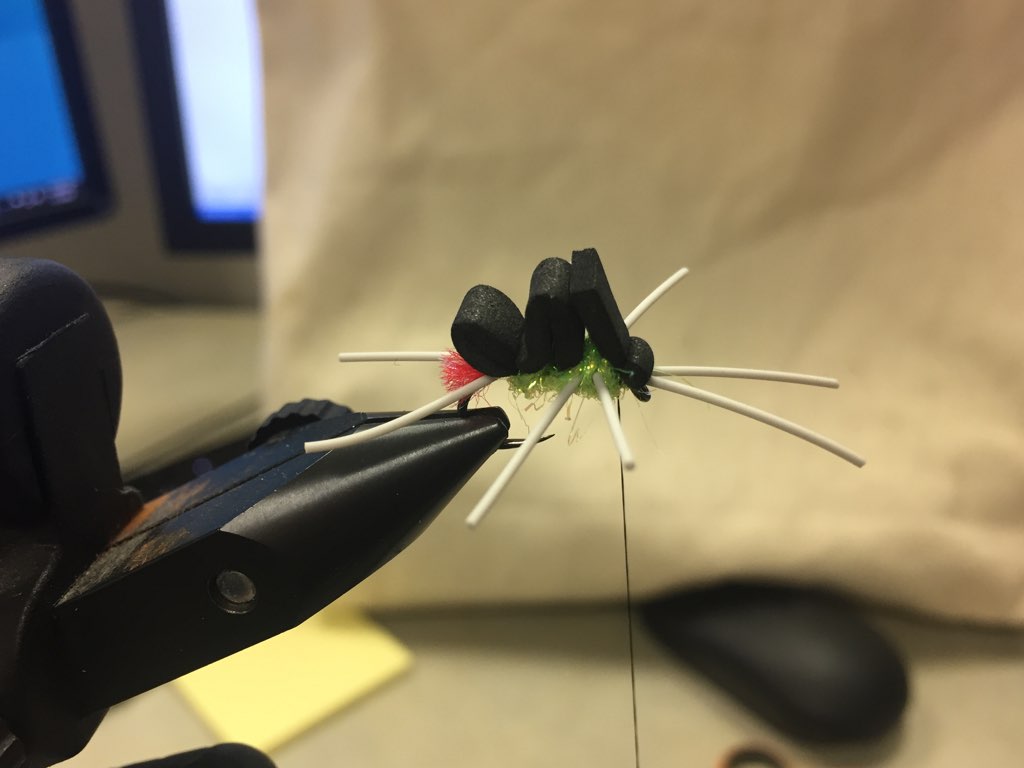
Probably my favorite fly to fish for panfish on local waters, when the fish are willing to rise, is a simple foam spider.  It's an extremely simple and effective fly.  The only problem I have ever had with this pattern is that it's not buoyant enough to float even a light dropper fly.  When I fish the spider and see fish near the fly but refusing to come to the surface, I want a dropper but am forced to switch flies or use an indicator to suspend the dropper where I want it.  The original foam spider I have used a lot in the past looks like this.


The thin piece of foam on the back of the fly floats it well right in the surface film and the wiggling legs prove irresistible to a lot of fish.  I toyed with multiple ideas to bump up the flotation on the foam spider, and I feel I finally have the pattern down the way I want it.  It floats incredibly well now, the fish still eat it, and it can support the weight of a small bead head dropper fly.  The recipe is as follows:

Hook - Firehole 633 size 12
Thread - Black 6/0
Legs - Round rubber
Tag - Laser Dub
Body - Black 2mm foam
Underbody - Ice Dub
Indicator - Orange (or other hi-vis color) foam chunk

Begin by tying in the rubber legs to the front, over the hook eye.  I prefer to double a single strand over the thread, tie it down, and fold the legs forward, covering the base of the legs with thread.  The legs should separate naturally under thread tension.


Not 100% needed, but I like to add a red hot spot tag to the rear.  I fold a small clump of Laser Dub over the thread and tie it down.  Trim the tag to end at the length of the bend of the hook.


Next add the rear set of legs.  Again double the strand of round rubber leg over the thread, tie it down, and cover the butts rearward.  It's ok if these legs stand upright a bit because the foam will force them down.


Tie in the strip of foam, ending with your thread at the base of the tag and legs.


The foam strip should be about the width of the hook gap.  I start with a strip about 3" long, and use all but what you see left here (the small chunk is leftover).


Fold the foam strip forward and tie it down with tight thread tension.  Your thread should stay at the same point on the hook, at the base of the tag/legs.


Dub some Ice Dub (I used chartreuse) onto your thread and wrap it tightly up against the base of the folded foam piece.


Fold the foam strip rearward again to create a second fold of foam body and tie it down tightly.  Continue wrapping thread to the hook eye, lashing the foam down securely.


Tie in the legs to each side using a couple of firm wraps to anchor them in place.


Dub around the legs, using the Ice Dub to prop the legs out and split them.  End with your thread near the hook eye.


Fold the foam back on more time and capture it with your thread behind the eye, forming a little foam head on the fly.  Trim the leftover foam strip to be about the length of the middle portion of the foam body.


Next tie down a small chunk of foam at the same tie in point for the head.  I prefer orange foam, and a small chunk is perfect.  Even  small piece of bright orange is very visible at a distance on the water.  Whip finish behind the hook eye and trim your thread.


Lastly, trim the leg length to your desired length.


Early testing in the tank with this fly has shown that it floats exceptionally well and has enough buoyancy to float a small bead head dropper (like the Nothin' Special).  Doubling the foam over twice allows for more foam to be packed onto the hook without making the fly too large.  By my estimation, tying the foam in using this method gets roughly three times the amount of foam onto the hook.  I fully expect this bug to get annihilated by bluegill once the weather warms and the fish start moving shallow.  It's a simple fly with materials most folks will have lying around their tying space.